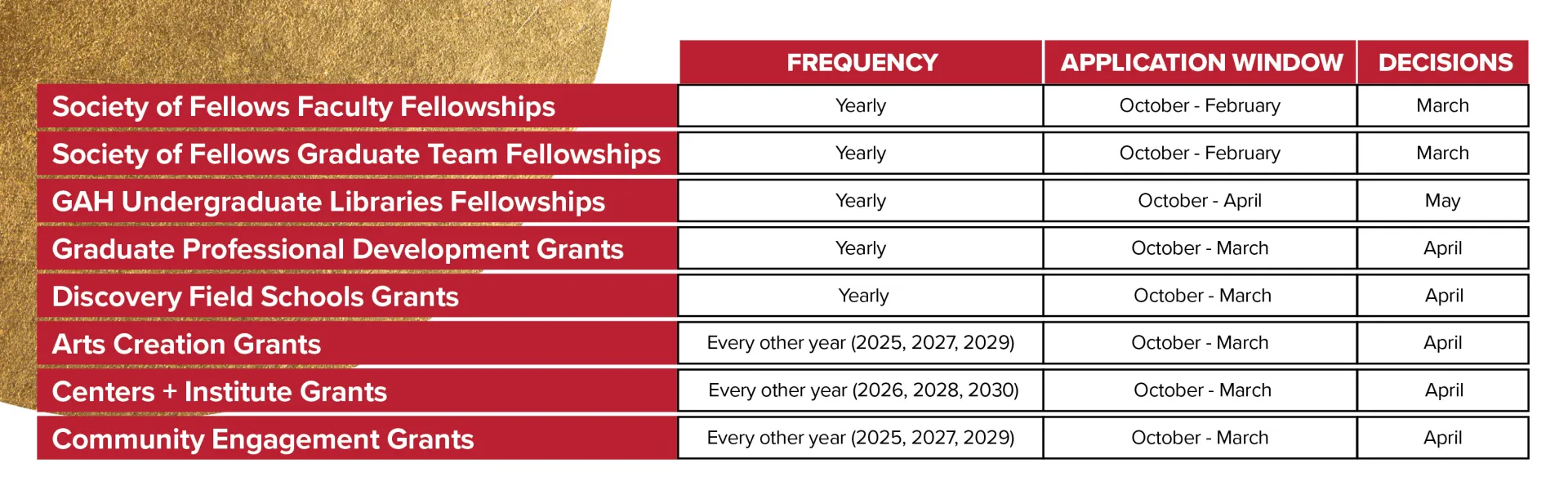
Funding Opportunities

- $5m Grants awarded for cross-disciplinary research and A+H interventions
- $1.5m Mentoring and cross-disciplinary research support for students
- 45% Grants invested in amplifying community-engaged projects
The Global Arts + Humanities' fellowships and grants recommit the university to the specific importance of the humanities and the arts to understanding, representing and addressing global concerns and creating an engaged research and learning community.
GAH facilitates cross-disciplinary collaboration in the arts and humanities by providing support in the form of research and creative practice grants; special funding initiatives; faculty, graduate and postdoctoral research fellowships; and experiential teaching and learning grants.
Funding Opportunities
OPEN | Society of Fellows: Ohio State Faculty Fellowships (Deadline: February 16, 2027)
SOCIETY OF FELLOWS | Ohio State Faculty Fellowships
2027-28 Theme: (Re)formations
DEADLINE: February 16, 2027
The Society of Fellows seeks to support projects that investigate re(formations) through arts and humanities disciplinary and cross-disciplinary orientations and/or community-engaged methods and practices.
2027-28 Annual Theme: (Re)formations
Christopher Nolan's adaptation of The Odyssey reminds us that humanity's oldest stories are endlessly open to reinterpretation. Homer's epic has been retold by generations of storytellers to resonate with their particular context and audience. Retellings of The Odyssey across media continue that work today — from hip hop albums to graphic novels, plays, musicals and video games — giving new form to contemporary concerns about war, exile, morality, ethics, and ideas about home and belonging. Even when a cultural form is canonized, the desire to re-form, reclaim and reimagine persists.
This year’s theme approaches (re)formations both as a verb — focusing on adaptation, reuse, translation and intertextuality as engines of critical inquiry and creation — and as a noun, referring to the social, political, institutional, physical and artistic forms shaped by those acts. Grounded in the Latin reformare (“to form again, change, or transform”), this framing reminds us that cultural forms are rarely as fixed as they appear. ‘Re-forming’ negotiates the space between convention and invention. What new meanings arise from recycling, remixing or mashing up past works, objects, ideas and practices?
(Re)formations are critical practices that compel ethical scrutiny. While revisionist work holds the power to uncover suppressed truths, it can also co-opt or distort. Furthermore, as forms shift and circulate, shared understandings are reconfigured. What is preserved, what is lost, and what new possibilities emerge through these practices? Who has the authority to transform inherited forms, whose experiences become visible and whose are erased? (Re)formations may also involve the refusal of the terms an existing form imposes by reclaiming how conventions distribute power, authority and codes of belonging.
The Global Arts + Humanities invites disciplinary and cross-disciplinary projects exploring the interplay between sources and iterations and/or the transformative potential of reforming existing structures. We welcome a wide spectrum of artistic and humanistic approaches including, but not limited to anthropology, architecture, classics, community engagement, dance, design, digital humanities, geography, history, literature, media studies, music, philosophy, public health, public policy, sociology, theatre and visual arts.
Eligibility and Release Time
Associate and full professors on all Ohio State campuses are eligible to apply. Preference will be given to associate professors for whom this support would facilitate promotion to full professor. Assistant professors who will have passed their fourth-year review at the start of the fellowship period are also eligible. Faculty must commit to being in attendance on the Columbus campus during the fellowship period so that they can participate fully in the monthly seminar, build community and attend related events.
During the fellowship period, and in accordance with college policy, faculty participating in the Society of Fellows will receive a two-course buyout, equivalent to 32% base salary and benefits. The Global Arts + Humanities will transfer these funds to the faculty member’s TIU. TIU heads will work with the faculty member to reduce service responsibilities in accordance with college guidelines and in line with unit needs. The fellowship may be taken concurrently with an Ohio State Faculty Professional Leave (subject to OAA approval). In such cases, the 32% release funds will be used to fund a special assignment with no teaching that may be combined with a one-semester FPL.
In addition to the release funds as indicated above, fellows will also receive $4,000 in research funds to be used during the fellowship year (no later than August 30, 2028).
Supplemental Mentoring Appointment
This year, we hope to appoint one SOF faculty fellow as a mentor to work with the SOF Graduate Team Fellows. In addition to a two-course release and $4,000 research stipend as an SOF faculty fellow, the faculty mentor will receive an additional $5,000 in supplemental pay. The faculty mentor will support graduate fellows in developing their own research and/or creative project, with administrative help from Global Arts + Humanities staff. We expect to offer six graduate fellowships. The mentoring program requires that students meet with the faculty mentor once per month during the academic year.
Applicants interested in a supplemental student mentoring appointment should indicate interest by checking the appropriate box on the application form.
How to Apply
All applications must be submitted online, where applicants will be guided through the application process for their proposal type.
Submit electronic copies of the following materials:
- A current curriculum vitae.
- A list of the leaves and fellowships held in the past three years.
- A 100-word abstract describing the project (research, creative, public-facing) the applicant will pursue during the term of the fellowship.
- A brief statement (1,000-1,500 words) describing how your project engages the annual theme, your interest in participating in a multi-disciplinary research community and the specific contributions you would hope to bring to the cohort.
- A sample of professional achievement (scholarship or creative activity) related to the fellowship theme (one published article, book chapter, or multimedia/video documentation of artistic practice).
- A brief supporting letter from the department chair committing to adjusting the applicant’s teaching and service responsibilities during the fellowship period. This letter should be submitted as part of application materials via the application webform.
Evaluation Process
Proposals will be evaluated by a subcommittee of tenured faculty from the Global Arts + Humanities Advisory Committee.
Timeline
- Call for proposals issued: October 15, 2026
- Application deadline: February 16, 2027
- Fellowships announced: April 1, 2027
- Research funds released: September 1, 2027
- Fellowship appointment begins: August 15, 2027
Contact
Email questions to Global Arts + Humanities Associate Director, Puja Batra-Wells (batra-wells.1@osu.edu).
OPEN | Society of Fellows: Graduate Team Fellowships (Deadline: February 16, 2027)
SOCIETY OF FELLOWS | Graduate Team Fellowships
2027-28 Theme: (Re)formations
DEADLINE: February 16, 2027
The Society of Fellows seeks to support projects that investigate re(formations) through arts and humanities disciplinary and cross-disciplinary orientations and/or community-engaged methods and practices.
The Society of Fellows Graduate Team Fellowship is a financial award given by the Global Arts + Humanities to recognize the cross-disciplinary aspirations and academic accomplishments of graduate students in the Division of Arts and Humanities in the College of Arts and Sciences. This program brings together a cohort of graduate students whose projects align with our Society of Fellows’s annual theme of (Re)formations, and it awards each student a year-long fellowship. The fellowship is open to students whose projects engage critical and/or creative practices, as well as students who seek to foster the development of participatory networks with local Columbus communities. Graduate Team Fellows may be at any phase of their dissertation research or terminal degree project.
2027-28 Annual Theme: (Re)formations
Christopher Nolan's adaptation of The Odyssey reminds us that humanity's oldest stories are endlessly open to reinterpretation. Homer's epic has been retold by generations of storytellers to resonate with their particular context and audience. Retellings of The Odyssey across media continue that work today — from hip hop albums to graphic novels, plays, musicals and video games — giving new form to contemporary concerns about war, exile, morality, ethics, and ideas about home and belonging. Even when a cultural form is canonized, the desire to re-form, reclaim and reimagine persists.
This year’s theme approaches (re)formations both as a verb — focusing on adaptation, reuse, translation and intertextuality as engines of critical inquiry and creation — and as a noun, referring to the social, political, institutional, physical and artistic forms shaped by those acts. Grounded in the Latin reformare (“to form again, change, or transform”), this framing reminds us that cultural forms are rarely as fixed as they appear. ‘Re-forming’ negotiates the space between convention and invention. What new meanings arise from recycling, remixing or mashing up past works, objects, ideas and practices?
(Re)formations are critical practices that compel ethical scrutiny. While revisionist work holds the power to uncover suppressed truths, it can also co-opt or distort. Furthermore, as forms shift and circulate, shared understandings are reconfigured. What is preserved, what is lost, and what new possibilities emerge through these practices? Who has the authority to transform inherited forms, whose experiences become visible and whose are erased? (Re)formations may also involve the refusal of the terms an existing form imposes by reclaiming how conventions distribute power, authority and codes of belonging.
The Global Arts + Humanities invites disciplinary and cross-disciplinary projects exploring the interplay between sources and iterations and/or the transformative potential of reforming existing structures. We welcome a wide spectrum of artistic and humanistic approaches including, but not limited to anthropology, architecture, classics, community engagement, dance, design, digital humanities, geography, history, literature, media studies, music, philosophy, public health, public policy, sociology, theatre and visual arts.
What Does it Mean to be a Graduate Team Fellow?
In addition to focusing on their own research (as mentored by their department faculty advisor), Graduate Team Fellows convene as a cohort to support each other’s evolving research and develop cross-disciplinary methodologies and understandings in their work. Graduate Team Fellows will be mentored by a Global Arts + Humanities Faculty Fellow with expertise in cross-disciplinary arts and humanities methods and practices.
Award Conditions
The Graduate Team Fellowship offers three consecutive semesters (autumn, spring, summer) of tuition and fees and a monthly minimum stipend of $2,897. The award includes travel and research support up to $500. Support also includes payment of general/instructional fees and any learning/technology fee. Special fees, such as COTA, recreational facility, Student Union, and study activity fees are not included. Graduate Team Fellows may not hold any other type of employment or appointment during the time of the fellowship.
Eligibility
- Must be a doctoral student or student in a three-year terminal degree program (e.g., MFA) in the College of Arts and Sciences.
- Must have a minimum cumulative grade point average of 3.6 for all Ohio State graduate courses.
- This is a residential fellowship. Fellows must maintain residency in Columbus, Ohio, for the duration of the award and attend all in-person meetings as scheduled.
- Fellowship funding may alter institutional or federal financial aid awards. Applicants receiving financial aid are advised to consult the Office of Student Financial Aid prior to submission.
Fellowship Obligations
The Graduate Team Fellowship requires fellows to meet for two hours each month during the autumn and spring semesters with fellow participants and their assigned faculty mentor to advance cross-disciplinary understanding and build community. Fellows are also expected to attend related events.
How to Apply
All proposals must be submitted online, where applicants will be guided through the submission process for their proposal type.
Submit electronic copies of the following materials:
- A complete curriculum vitae.
- A brief statement (two single-spaced pages) that:
- Describes your creative or scholarly project.
- Specifies how much of the project you have already completed.
- Describes how the project engages the 2027-28 Society of Fellows’ theme: (Re)formations.
- Describes the work that the fellowship will allow you to complete.
- A letter of support from your advisor that conveys the advisor’s appraisal of the project’s progress and benefit from participating in a multi-disciplinary research community, the relevance of the project to the field of study, your unique contribution, and the value of the fellowship to your overall graduate pursuits. Advisors should email the letter directly to Global Arts + Humanities Associate Director Puja Batra-Wells (batra-wells.1@osu.edu).
- If your project involves a community partnership, it is highly recommended that you provide an additional letter of support from the community partner.
- A current transcript and/or academic advising report.
NOTE: No ancillary materials, such as DVDs or CDs, will be accepted. Web addresses linking to ancillary materials may be included as appropriate in the research statement.
Evaluation Process + Criteria
- Applications will be evaluated by a subcommittee of the Global Arts + Humanities Advisory Committee, which is comprised of senior members of the graduate faculty.
- The advisory committee will consider all the required information presented in support of the application. Evaluation will focus on the quality of the research or creative project proposed; the project’s link to the Society of Fellows annual theme, (Re)formations; potential benefit of the applicant’s participation in and contribution to the multi-disciplinary cohort; and the student’s ability to undertake the dissertation or degree project within the fellowship tenure as evaluated primarily by scholars outside the nominee’s area of study.
Timeline
- Fellowship call issued: October 15, 2026
- Application deadline: February 16, 2027
- Fellowships announced: April 1, 2027
- Fellowship award period: Begins autumn 2027
Contact
Email questions to Global Arts + Humanities Associate Director, Puja Batra-Wells (batra-wells.1@osu.edu).
OPEN | Undergraduate Fellows Program (Deadline Extended: April 1, 2027)
SOCIETY OF FELLOWS | Undergraduate Fellowships
2027-28 Theme: (Re)formations
DEADLINE: April 1, 2027
The Undergraduate Fellows Program is designed for advanced undergraduates engaging in thesis projects, independent study courses or other in-depth research projects (including creative and performance projects) in arts and humanities disciplines. The program supports fifteen fellows throughout the research process and provide an opportunity for them to learn from peers in other disciplines.
For those students whose research aligns with the Global Arts + Humanities Society of Fellows annual theme, (Re)formations, students will have opportunities to engage with Society of Fellows programming throughout the academic year. Note: Alignment with this theme is not required to apply for this fellowship.
Who Should Apply?
Advanced undergraduate students undertaking a cross-disciplinary research project in an arts and humanities discipline during the 2027-28 academic year. Research projects may include an undergraduate thesis, independent study or other in-depth research project (including creative and performance projects).
What Does the Fellowship Involve?
Student fellows will meet monthly (September through April) in cohorts to learn core research skills and practices and to engage in shared research experiences with other fellows. This will include eight 90-minute sessions in total. Fellows will also meet individually with their University Libraries faculty mentor or other University Libraries experts (subject librarians, curators, archivists, specialists, etc.) each month to receive additional guidance on their research projects. The program is designed to support the work fellows will be doing, not to be additional work.
How Will this Benefit Me?
- You will receive expert guidance and mentoring in learning research skills and practices to support your research project.
- You will develop a network of peers in other disciplines through participating in a cohort.
- You will gain experience developing proposals and presentations on your research for events, such as the Denman Undergraduate Research Forum.
- You will join a community of young scholars at Ohio State and learn about opportunities for presenting and publishing your research.
- You will receive a total of $1,000. Funds ($500) disbursed each semester.
How to Apply
Complete the fellowship application by April 1, 2027, and have your advisor submit a brief letter of support to the program coordinator, Craig Gibson (gibson.721@osu.edu), by the same deadline. Successful applications will include a clear description of the research project aims and how you will benefit from the program.
Contact
Email questions to Program Coordinator Craig Gibson (gibson.721@osu.edu).
OPEN | Centers + Institutes Grants (Multiple Deadlines)
CENTERS + INSTITUTES GRANTS
Deadlines
Concept papers: December 14, 2026
Full proposals: April 1, 2027
Decisions: May 1, 2027
Purpose
Centers + Institutes Grants advance the mission and goals of the Global Arts + Humanities | Cross-Disciplinary Research Exchange by enhancing the capacity of centers and institutes for cross-disciplinary collaborations that foreground humanistic methods and practices in addressing critical societal challenges.
Grant Types
- Center Grants: Proposals with budgets between $5,000-$25,000 will be accepted from the directors of individual centers.
- Collaborative Center Grants: Proposals with budgets between $25,000 and $50,000 will be accepted from directors for projects that support cross-disciplinary collaboration between two or more centers or for institutes that house multiple centers or programs. Proposals for postdoctoral and post-MFA positions will also be accepted; however, these positions will only be considered for funding if a 50% share is available. Collaborative Center Grants may support projects lasting one to two years.
- Summer Institutes and Program Grants: Proposals from directors of centers/institutes or cross-disciplinary programs may apply for projects with budgets between $5,000-$15,000 for short-term, cross-disciplinary research, teaching and/or community-engagement initiatives.
Priority Consideration
Priority consideration will be given to new and ongoing projects with sustainable programmatic and/or curricular alignments supporting and integrating cross-disciplinary education, outreach and research opportunities that foreground humanistic methods and practices in addressing critical societal challenges.
Timeline
- Call for concept papers issued: October 15, 2026
- Deadline for two-page concept proposals: December 14, 2026
- Target date for concept paper decisions: February 1, 2027
- Deadline for full proposals: April 1, 2027
- Target date for final decisions: May 1, 2027
- Funds released: June 1, 2027 (or thereafter)
How to Apply
This year’s centers and institute grant competition consists of short concept papers, which a subcommittee of GAH’s Advisory Committee will review. The review committee will recommend a ranked list of the most viable projects to the faculty director, who will invite full proposals.
Proposals must be submitted online, where applicants will be guided through the submission process for their proposal type.
Concept Paper Guidelines
Deadline: December 14, 2026
Center and institute directors are invited to submit individual or joint concept proposals that align with GAH’s mission, goals, and commitment to enhancing the university’s capacity for cross-disciplinary research, teaching and outreach that integrate arts and humanities methods and practices in meaningful ways.
Applicants should include a two-page, high level overview of the proposed project with the following required content and format:
Include a header with the following three lines:
- Line one: Descriptive project title.
- Line two: Name of contact PI/units (each proposal may have no more than two project leaders, one of which must be the center or institute director).
- Line three: Type of grant (Individual Centers Grant/Collaborative Centers Grant/Summer Institute Grant).
The body of the concept paper must provide the requested information, which will also be used as evaluation criteria for this initial phase. Please use the following five headings:
- Focus: Clearly convey and describe the challenge/research questions to be addressed.
- Approach and audience: Outline the cross-disciplinary approach, how the project will be pursued, how the project will integrate arts and humanities methods and practices, and the target audience(s)/community(ies) to be involved.
- Relevance and impact: Identify expected outcomes and how they will be measured.
- Diverse perspectives and engagement: Convey how the project will foster diverse perspectives and engagement.
- Institutional ecology and networks: Indicate how the project will build on existing initiatives, resources and expertise, including evidence of the prior experience and/or relevant scholarship of the project director(s) related to the proposed project (do not attach CVs).
Full Proposal Guidelines
Deadline: April 1, 2027
Center and institute directors invited to submit full proposals should follow these guidelines:
- All proposals must align with GAH’s mission, goals and commitment to enhancing the university’s capacity for cross-disciplinary research, teaching and outreach that integrate arts and humanities methods and practices in meaningful ways.
- Faculty and staff compensation may include:
- Compensation for project leaders: Proposals may request a course release at the lecturer rate or supplemental or off-duty pay of $5,000 (for the labor equivalent to that of a course release) for the center or institute director and for a current tenure-track faculty or staff member (with PI status) to help implement the program. Each Center Grants Proposal may have no more than two project leaders, one of which must be the center or institute director. If requesting course releases, please include a letter of support from each project leader’s department chair.
- Faculty and staff collaborators: Depending upon the scope of their contributions to the project, collaborators can be allocated between $500-$2,000 in cash as research funds for up to a maximum of $10,000 to be divided evenly among teams that consist of five or more collaborators. All proposals must indicate how these research stipends will be divided. Project leaders who receive a course release or supplemental pay are not eligible for research stipends.
- Proposals should run no more than eight double-spaced pages, including appendices or data (excluding CVs) and must include a detailed, itemized budget of one to two pages. Proposals should include an explanation of the cross-disciplinary project’s relevance and impact, vision for meaningful involvement of students, and potential for developing strong and sustainable cross-disciplinary collaborations with other units on campus and/or with community partners. Proposals should also describe how the project will engage diverse perspectives and audiences.
- Proposals for two-year initiatives should clearly outline the planned phasing for their initiative’s development and structure the budget according to the designated phases. Proposals may request cash allocations for such items as student programs; public or academic lectures, presentations, or conferences; consultations; working groups; planning innovative and/or experiential cross-disciplinary teaching and learning opportunities; documentation (podcasts, videos, website development); student support, including small grants for undergraduate and graduate student research; GAA tuition and fees; and costs for rental equipment, campus space, printing, or design necessary for the research and/or creative project. These suggestions are intended to be illustrative and not exclusive. Applicants are encouraged to be visionary and imaginative in thinking about possible applications of funds. Operations costs, like faculty and staff salaries, will not be supported.
- Proposals should include a description of the documentation (performance, podcasts, blogs, videos, website, publication, etc.) the project will produce. Additionally, proposals should include a description of a plan and/or method for developing documentable evidence of success and indicate how the center or institute will measure the outcomes of their proposal in achieving demonstrably transformative, cross-disciplinary educational goals, within or across curricula, research, and/or community engagement. Directors will be required to submit an annual report to GAH, which will be reviewed by the faculty director and GAH leadership. Indicate the potential of the proposed initiative to secure extramural (non-Ohio State) funding, and please note if any additional funding has already been secured. Sources of funding may be identified using this Office of Research resource: research.osu.edu/award-lifecycle/funding/.
- Center/institute directors will be the points of contact for communications with GAH during the grant program process. Funds will be released to and administered by the center/institute.
Full Proposal Evaluation Criteria
- Cross-disciplinary relevance and impact: Does the project imagine cross-disciplinary research, creative expression, teaching and/or outreach collaboration that foregrounds the transformative power of arts and humanities methods and practices? What is the project’s potential for increasing Ohio State’s national recognition and distinction in the integrated arts and humanities?
- Student impact and engagement: How will the project meaningfully engage students and positively impact their educational experiences and/or professional development?
- Potential for collaboration: Does the project put forth a vision for collaboration across the university community? How will the project address the challenges of conducting intellectual work across disciplines and among faculty, students and community stakeholders?
- Institutional ecology and networks: To what extent does the project build on existing initiatives, resources and expertise? Does the project build on new or established local, national and/or international networks or collaborations? What kinds of consultation have already taken place or are planned?
- Diverse perspectives and engagement: Does the project encourage the engagement of diverse perspectives and audiences?
- Extramural funding: What is the project’s potential for securing non-Ohio State funding?
Contact
Applicants may email questions to GAH Associate Director Puja Batra-Wells (batra-wells.1@osu.edu).
OPEN | Field School Teaching Grants (Deadline: March 15, 2027)
FIELD SCHOOL TEACHING GRANTS
DEADLINE: March 15, 2027
Ohio State faculty are invited to submit proposals for a Field School Teaching Grant. Field schools are faculty-led, interdisciplinary, experiential-learning programs. These can be offered as a one-credit undergraduate course or group independent study that takes students to domestic destinations to learn about the transformational value of the humanities and the arts. By immersing students in learning environments, field schools aim to close the gap between knowing and doing.
Renewable annual grants of up to $15,000 will be awarded for field schools that deepen student cross-disciplinary engagement and experiential learning in arts and humanities.
Faculty Leaders
Field schools are led by tenure-track faculty. Lecturers, postdoctoral researchers and staff may co-lead a field school as long as the primary leader is a tenure-track faculty member. It is expected that an approved field school will be offered two times over a period of three years. Lecturers interested in proposing a field school must be on a multi-year contract to fulfill this obligation. Each field school is approved with the understanding that approval is attached to the individual faculty member or pair of faculty members leading the field school. If the field school is to be offered with a different instructor(s) or for an additional cycle, it must be resubmitted for funding approval.
Faculty Compensation
Faculty leaders are provided $3,000 in cash as research funds for the initial field school offering and $2,000 in cash as research funds for the second offering. If two faculty members lead a field school, each leader will be provided $2,000 per the initial field school offering, and $1,000 in research funds for the second time it is offered. This compensation is not part of the budget for the project.
Course Offering
Field schools are offered during the autumn and spring semesters, with travel occurring during the semester the field school is offered. The immersive learning experience, including travel to and from the learning site, should last between three and seven days. Faculty are responsible for course creation with the registrar and are encouraged to schedule field schools to correspond with semester breaks to try to forestall students missing their regularly scheduled courses. However, if a field school should require students to miss their other classes, the Global Arts + Humanities will provide an official letter for students to share with their instructors to excuse them from classes during the field school.
Course Requirements
Field schools have three core components:
- A pre-travel assignment designed to prepare students for their immersive-learning experience.
- A three-to-seven-day travel experience.
- A post-travel assignment designed to prompt students to reflect deeply on their immersive-learning experience. All assignments should be commensurate with a one-credit course.
Course Enrollment
A minimum enrollment of four undergraduate students is required to run a field school. The maximum enrollment is twelve undergraduate students.
Learning Sites
Field schools are reserved for immersive-learning experiences at sites within the United States.
Community Partner(s)
Field schools are conducted in coordination and collaboration with one or more community-based partner(s) at a learning site. The extent of the coordination and the nature of the collaboration should reflect the field school’s expressed student learning outcomes.
Community partners should also be willing to collaborate with the field school for at least two years so that the field school can be offered twice during a three-year period. Community partners can be compensated for the collaboration. Please note that this compensation must be allocated from awarded grant monies.
Student Application Process
Students apply for a field school by submitting a copy of their transcript and a 250-word essay explaining their interest in the field school and their expected outcomes from participating if selected. The field school faculty leader is responsible for advertising the field school on relevant university platforms, soliciting and reviewing applications and selecting applicants. Graduating seniors must contact the course faculty leaders to verify their eligibility.
How to Apply
All applications must be submitted online, where applicants will be guided through the application process for their proposal type.
Proposal Guidelines
- Narrative description of proposed field school (one page), including:
- Learning site rationale: A description of the field school learning site, along with a rationale for the learning site as a destination for an immersive educational experience.
- Community partner rationale: A description of field school community partner(s), with an explanation of the partner’s relevance to the field school, commitment to coordinate and collaborate with the field school and likelihood of engaging in a sustained relationship with the field school.
- Course plan (up to five pages):
- Student learning objectives: A description of the primary learning objectives for students who participate in the field school.
- Documentation: A description of the form of documentation (e.g., performance, podcasts, videos, blogs, website, publication, or performance) that the field school will produce, which can be featured on the Global Arts + Humanities website.
- Course requirements: A description of the pre- and post-travel assignments, with an explanation of how the assignments will facilitate connections between the learning site and course objectives.
- Faculty leader biography: A description of the field school leader’s professional background, with an explanation of what makes them uniquely qualified to lead the proposed field school.
- Itinerary: A draft itinerary chronicling the order of activities at the field school learning site.
- Itemized budget (up to two pages): An estimated cost of transportation to, from, and at the learning site; cost of food and lodging; and fees for learning experiences/excursions. The budget should also include estimated costs for associated administrative fees and/or honoraria for community partners.
- Letter of commitment from community partner(s): A letter from community partners attesting to their willingness to coordinate and collaborate with the field school on a multi-year basis.
- Letter of administrative support from department chairperson: A letter of support from the chairperson of the faculty leader’s department attesting to the department’s willingness to provide administrative support for the field school through the department’s course enrollment manager and fiscal officer. Field schools do not count toward a faculty member’s regular course load. The stipend constitutes compensation for the additional one-credit course with the usual semester course load maintained.
Timeline
- Call for proposals issued: October 15, 2026
- Application deadline: March 15, 2027
- Target date for decisions: April 15, 2027
Contact
Email questions to Global Arts + Humanities Associate Director, Puja Batra-Wells (batra-wells.1@osu.edu).
OPEN | Graduate Professional Development Program
GRADUATE PROFESSIONAL DEVELOPMENT GRANTS
DEADLINE: March 15, 2027
Purpose
To advance the mission and goals of the Global Arts + Humanities by enhancing the professional development of graduate students (MFA, DMA, PhD) through their collaboration in cross-disciplinary research, educational programming, and community-engagement initiatives in the arts and humanities.
Graduate Professional Development positions aim to:
- Embed graduate students in humanities and arts MFA, DMA, or PhD programs in university entities or initiatives involved in cross-disciplinary research/creative work to facilitate the student’s professional development.
- Establish a mentoring framework that will guide the student’s engagement, illustrate best practices and thresholds for achievement, and hone praxis-based skills.
Award Conditions
- Proposals may request funding for a Graduate Professional Research Associate position at 25% for one-to-three semesters, beginning summer 2027 or autumn 2027. Aligned with Graduate Research Associateships, these positions will follow the same guidance and policies established by the Graduate School (Section 9.2, Terms of Appointment, Reappointment, or Termination). The university establishes a minimum stipend for GRAs of $4,820 for a semester-long, 25% appointment with an average load of ten hours per week over the duration of the appointment period. Graduate Professional Research Associates may not hold an appointment for more than 75% time as a combination of appointments. GAH will cover 50% tuition and fees associated with a 25% appointment if the candidate holds no other appointments.
- These positions may be distributed across one-to-three semesters. Hiring units must undertake their own searches to make these appointments. The search should include a detailed description of 1) The roles/tasks that the graduate student will undertake as part of their contribution to the relevant project, 2) How the role will contribute to their professional development, and 3) The types of mentorship that will be made available.
Eligibility
Department, center, institute or program chairs and directors may apply for these grants to advance existing or new cross-disciplinary initiatives. Graduate students are not eligible to apply for these awards directly. Previously funded Global Arts + Humanities projects that have identified new opportunities for graduate student professional development are eligible to apply for these funds.
How to Apply
All applications must be submitted online, where applicants will be guided through the application process for their proposal type.
Proposal Guidelines
Department, center, institute or program chairs and directors are invited to submit proposals that:
- Align with the Global Arts + Humanities’ mission and clearly explain the position’s relevance and impact for the department, center, institute or program in terms of its contributions to cross-disciplinary research and/or community engagement and education in the arts and humanities. Proposals may request a Graduate Professional Research Associate at 25% for one-to-three semesters to work with department, center, institute or program chairs/directors and staff to implement this vision. Proposals should run no more than six double-spaced pages.
- Include a precise job description detailing a meaningful vision for the graduate student’s professional development and its relevance to academic and/or alt-ac career possibilities. Proposals must also describe how the position will encourage the engagement of diverse perspectives and audiences.
- Describe the forms of outcomes (performance, podcasts, videos, blogs, website, catalogue/database, publication, curriculum, etc.) that the project aims to produce and the graduate student’s role in helping to achieve these deliverables.
- Include a plan for mentoring the graduate student to achieve demonstrably cross-disciplinary research or educational goals. Note that grant recipients and their mentees will be required to submit an end-of-year report which will be reviewed by the Global Arts + Humanities faculty director. Department, center, institute or program chairs/directors who apply will serve as the graduate student’s mentor and point of contact for communications with the Global Arts + Humanities for the duration of the appointment.
Evaluation Process + Criteria
- Cross-disciplinary relevance and impact: Does the proposal identify the contributions that the position will enable for the hiring unit? Do these align with the Global Arts + Humanities’ mission in terms of its contributions to cross-disciplinary research and/or community engagement and education that amplify the value of arts and humanities methods and practices?
- Imagined outcomes: Does the proposal offer a clear description of the activities the graduate student will engage in, the professional skills that will be cultivated thereby and the potential career relevance of these? For example, the student might play a role in delivering services (such as training or consultation), creating a resource or product (such as a curriculum, catalogue, or performance) or supporting an organization (such as writing a grant, designing a community partnership, or managing a journal).
- Mentoring plan: Does the proposal envision meaningful involvement of faculty mentors and provide a clear description of the mentoring process for the graduate student?
Timeline
- Call for proposals issued: October 15, 2026
- Application deadline: March 15, 2027
- Target date for decisions: April 15, 2027
Contact
Email questions to Global Arts + Humanities Associate Director, Puja Batra-Wells (batra-wells.1@osu.edu).
OPEN | Co-Sponsorship Opportunities (Rolling Deadlines)
CO-SPONSORSHIP OPPORTUNITIES
Rolling Deadlines
Global Arts + Humanities co-sponsorships provide support for events that align with the GAH mission and core goals. Sponsorship requests may not exceed $500.
Student applications must include a letter of support from a tenure track faculty member from the Division of Arts and Sciences.
Requests are accepted on a rolling basis and are reviewed by the Global Arts + Humanities Leadership Committee. These requests must be submitted using the application webform.
Please allow for two weeks' lead time when submitting requests.
Global Arts + Humanities Funding Timelines